


Allan L. Klein, MD, FRCP(C), FACC, FAHA, FASE
- Professor of Medicine
- Cleveland Clinic Lerner College of Medicine of Case
- Western Reserve University
- Director, Cardiovascular Imaging Research
- Director, Center for the Diagnosis and Treatment of Pericardial Diseases
- Department of Cardiovascular Medicine
- Heart and Vascular Institute
- Cleveland Clinic
- Cleveland, Ohio
Rumalaya gel dosages: 30 gr
Rumalaya gel packs: 1 tubes, 2 tubes, 3 tubes, 4 tubes, 5 tubes, 6 tubes, 7 tubes, 8 tubes, 9 tubes, 10 tubes
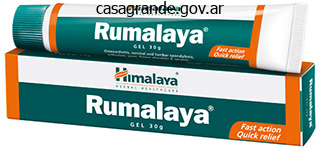
Purchase rumalaya gel 30gr with amex
Her bodily examination is simply vital for icteric sclera, petechiae on her lower extremities, and a quantity of other bruises on her forearms which are over 2 cm. A 48-year-old woman is being evaluated for hyperferritinemia found during analysis of transaminitis 2 weeks earlier. A 22-year-old healthy woman is referred for evaluation of increased iron saturation discovered during a workup for delicate anemia. The patient is a school scholar who was feeling fatigued for a number of weeks and went to the scholar well being service where her hemoglobin was found to be mildly decreased. Her laboratory studies are shown: this most likely displays which genetic abnormality A 42-year-old man presents for analysis of anemia that has been current since start. He has required blood transfusions throughout his life despite lack of apparent bleeding. He has not been responsive to oral iron and has only been partially aware of intravenous iron preparations. He has a loud P2 on cardiac auscultation, an inspiratory S3, and clear lung fields. A 65-year-old man is in the hospital awaiting liver transplant for liver failure secondary to autoimmune hepatitis. Two days prior, he started to develop a progressive anemia regardless of absence of apparent blood loss. He has had a deterioration of neurologic function, a rise in ascites, and worsening coagulopathy during the same time interval. For the three days prior to presentation, he complained of great right upper quadrant ache and was recognized with hepatic vein occlusion. A 43-year-old development employee is referred to you for analysis of blistering pores and skin lesions over his arms and palms for the past 4 years. The patient wears short-sleeved shirts and spends much of the day working within the solar. His medical history is important just for previous intravenous drug use when he was in his 20s. Physical examination is significant for a number of well-healed skin lesions over his palms and arms. A 42-year-old lady with a 20-year history of celiac illness presents with anemia. The patient has been somewhat Which of the following is most appropriate laboratory analysis for this patient presently A 55-year-old man underwent orthotopic liver transplant for end-stage liver disease secondary to continual hepatitis C 10 days prior. You are asked to see the patient to evaluate hemolytic anemia that started 24 hours after surgical procedure. The patient had an uneventful operative course and received eleven units of purple cells along with platelets and plasma. The affected person is blood sort A optimistic and received a liver from an O constructive donor. His different laboratory studies are solely important for complete and unconjugated bilirubin of seven. A 20-year-old lady with a historical past of kidney transplant 5 years previously for renal failure secondary to ureteral reflux presents with erythrocytosis. The affected person was diagnosed 2 weeks prior when she underwent routine laboratory testing. A 23-year-old man presents to the emergency department with liver failure and hemolysis. The patient has an unknown past medical history but was brought in by a neighbor who was nervous.
Buy rumalaya gel online now
The tailor-made properties meet a particular useful want dictated by the actual composite biomedical application(s). In this case, the problem is compounded as refined understanding of blood contacting performance necessities nonetheless lack. The area of biomedical materials and gadget improvement (composite or otherwise) has ushered an explosion of technological improvements over the previous a quantity of many years. Two particular obstacles deserve consideration: (1) absence of translational research focus in educational research (the major hotbed of innovation), and (2) cautious, sluggish, and costly regulatory pathways, with (at times) unrealistic/confusing demands on validation. Such calls for, as a rule, are the results of a regulatory infrastructure that retains enjoying "catch-up" to the ongoing innovation wave. The roadmap of this chapter takes the reader by way of each clinical application gadget category (heart valves, vascular grafts, and stents). Within each category, the medical burden and related pathophysiological problem are stated. Then, the current innovation towards simpler blood-surface interactions is launched. The structural requirements refer to meeting the anatomy of the diseased structure being replaced/augmented when it comes to placement, size, and macro/micro-architecture, while the functional requirements handle the appropriate flow/blood pressure wants across the valve with its inherent hemocompatibility habits. While for the aim of providing some categorization context, it may be helpful to separate the design standards as described above, device design must contemplate their symbiotic action. For instance, hemcompatibility relies on physiological forces across the gadget, its practical traits, in addition to the type of structural materials getting used, their dimension and side. Simply put, each category closely is dependent upon the other, in a vicious cycle that seems to defy the human capability to obtain the perfect replacement (as good as the unique in any respect ranges of construction and function). This is the purpose where the "design compromise" comes into play, and the debate on which parameters are extra important stirs the scientific and medical communities. It have to be recognized that the limiting consider qualifying the system as hemocompatible is its blood-surface habits. While recognizing the multidimensional and symbiotic relationship between surface and bulk, the material introduced will strictly address blood-surface options. The common ideas of getting ready a surface for a specific interaction stay the identical whether or not the interplay is with circulating blood or in an in situ static setting (where blood is present). The intention is to management the deposition of proteins, the era of thrombin leading to blood coagulation, the platelet adhesion adopted by aggregation and activation, and the surrounding tissue environment response to the presence of the alternative (cellular migration/inhibition, scar formation, and so on. Physical, chemical, and biofunctional strategies have been developed to (theoretically) achieve varied levels of hemocompatibility. The objective of those strategies is to current a less "overseas" floor to the circulating blood and stimulate a close-to-natural means of healing/integration throughout the native setting. Manipulating surface topography can present a selective method of including/excluding the floor binding of varied blood entities based mostly on measurement. While perhaps crude, this bodily approach supplies a venue to manipulate floor roughness in meeting particular inclusion/ exclusion criteria. Surface roughness also impacts the potential for blood cells navigating over its surface. A rough surface will result in excessive shear of the circulating blood and its components resulting in undesirable (especially) cellular harm, as these parts are obtainable in contact with the floor. Some of the more superior bodily modification methods embrace deposition of polymer films/islands, nanoparticles, metallographic paper or diamond paste polishing, sand blasting, photolithography, and e-beam etching. Physical strategies expand beyond floor roughness and into physical immobilization supposed to enhance the inherent material properties in the path of an improved diploma of hemocompatibility. Some of these strategies embody polymer gelling (addition of progress factor cocktails in the liquid state of the fabric; addition of components that modify the inherent pH/chemical stability leading to the formation of managed nano-pores) emulsion methods (addition of factors insoluble in aqueous solutions) or excessive stress gas foaming (incorporation of development components into porous scaffolds, without using solvents). Chemical methods help manipulate the way by which blood certain elements "see" the gadget floor. One established example is floor wettability (measure utilizing contact angle methods). The method that achieves numerous ranges of wettability instantly modulates the hydrophobicity/hydrophilicity of the surface to meet particular blood contacting requirements. In addition, given the nonfouling diploma of the material used, its hemocompatibility can be enhanced via the process a "passivation" to obtain a nonadhesive, nonbiofouling surfaces. Chemical functionalization can be used to enhance the diploma of hemocompatibility. Covalent modifications that include surface and bulk distribution of ligands have been proven helpful.
Rumalaya gel 30gr visa
Jugular vein pulsations could happen from an induced artifact of transmitted carotid arterial stress waves. This artifact can be acknowledged by an irregular pulsation usually obscuring the X descent. The irregular wave shows a carotidlike contour, with the dichrotic notch recog nized in the middle of the X descent [11]. Tavel [14] notes that tricuspid insufficiency usually produces a outstanding V wave, beginning early and tending to obliterate the X descent. In severe tricuspid regurgitation, the V wave corresponds and begins with the C wave and exhibits a broad plateau terminating in a steep Y descent. In the setting of atrial fibrillation, practically complete obliteration of the X descent is required before making the prognosis of tricuspid insufficiency from a venous pulse wave. In patients with regular sinus rhythm, changes in the venous pulse suggesting tricuspid regurgitation could show solely slight lower in the X descent equal to or above the extent of the Y trough. In some sufferers, a separate systolic wave may seem on the V wave ascent and may be an obscured clue to the presence of tricuspid regurgitation [13]. The attribute pulse waves could also be absent at relaxation but introduced on by inspiratory maneuvers or rising heart price [13]. Identical matching of the proper atrial and right ventricular diastolic pressures is the norm. The A wave (atrial contraction) of the proper atrial strain cor responds to the A wave of the best ventricle. As proper ventricular stress falls below proper atrial pres positive, the tricuspid valve opens, releasing atrial pressure (the Y descent of the V wave). This widespread artifact using fluidfilled systems is necessary to contemplate when assessing tricuspid and pulmonary gradients. These pressures were meas ured constantly on pullback of a fluidfilled transseptal Brockenbrough catheter. The mean left atrial stress is elevated roughly 22 mm Hg with putting A and V waves. There are two principal negative or downward motions of the proper (and left) atrial stress waves. The X trough outcomes from movement of the tricuspid (or mitral) valve away from the atrium when intrapericardial stress is lowering immediately after ventricular con traction begins and left ventricular quantity falls. There is a reciprocal relationship between strain and right atrial or venous flow. The V wave reflects the pressure�volume relationship (also often identified as compliance of the atrium) and will be mentioned in the review of the V wave under. The left atrial V waves are usually greater than V waves on the right atrial stress where the A wave predominates. Systolic Regurgitant Right Atrial Waves In distinction to large cannontype waves, positive systolic strain waves on the right atrial tracing may be as a result of an incompetent or occasionally a stenotic tricuspid valve. A 50yearold lady with atrial fibrillation and a history of rheumatic fever has rising pedal edema and dyspnea. The right atrial strain matches the best ventricular strain in diastole, and rises throughout the systolic interval of proper ventricular ejection, which is the most typical strain wave sample of tricuspid regurgitation [12]. As anticipated in atrial fibrillation, the best atrial and ventricular A waves are absent. A promi nent Y descent happens after the point of the maximal proper atrial pressure (V wave) and falls sharply with the drop in right ventricular pressure. Note that the dias tolic pressures of the best atrial and proper ventricular tracings are nearly identical throughout the vast majority of diastole. If the catheters are zeroed, calibrated correctly, and the resonant options and sensitivity of the 2 fluid crammed systems are matched, small diastolic gradients of tricuspid stenosis may be reliably determined. Pulsatile Venous Waves A 39yearold woman with severe ascites and dyspnea at rest has large V waves throughout jugular vein examination and a pulsatile liver. Early diastolic right ventricular stress drop is related to an early right atrial�right ven tricular pressure gradient which equilibrates before the primary onethird of diastole following a speedy decline, reflecting mostly excessive circulate and not essentially signifi cant tricuspid valvular stenosis. The marked regurgitant waves seen on the lower panel are measured in the femoral vein. The timing of the V wave is coincident with the electrocardiographic T wave, but may be simply confused with an arterial pulse of low amplitude. The right atrial strain (upper panel) dem onstrated a distinguished regurgitant wave with fusion of A and V waves, an absent X trough, and a marked Y descent.
Purchase rumalaya gel 30gr line
Of notice, grade three or larger related antagonistic events had been reported in over 40% of patients in the ipilimumab arm. In this young patient with solely a history of melancholy, it will be affordable to provide ipilimumab. In this patient, there are radiographic indicators and scientific symptoms of pneumonitis associated to the pembrolizumab therapy. An electrocardiogram and serum cardiac enzymes might be obtained to rule out a cardiac etiology. The activated cells are then intravenously administered again to the affected person as a collection of three treatments. Antitumor responses can occur both on the injected and the noninjected tumor sites. B Switch to intravenous methylprednisolone 1 mg/kg q12 hours, check for latent tuberculosis and monitor. The affected person on this query has initially developed grade 2 diarrhea/ colitis, which then progresses to a grade 3 degree regardless of appropriate outpatient remedy with prednisone at 1 mg/kg. Infection and other causes of diarrhea have to be thought-about, however in a patient handled with ipilimumab 10 mg/kg, immunemediated diarrhea or enterocolitis is often the most probably analysis and requires prompt remedy. In sufferers not responding to oral prednisone as an outpatient, admission 17 to the hospital for supportive care and intravenous corticosteroids is required. Because of the potential threat of reactivation of latent tuberculosis with infliximab, ruling this out with assays, such as a commercially available interferon-gamma launch check, is a good consideration previous to administration. In particular, sufferers can endure a big cardiovascular leak syndrome resulting in hemodynamic instability. A 78-year-old male introduced to his primary care physician reporting weakness for three months. He was also famous to be mildly anemic on a routine blood take a look at that was done a yr ago, however no additional workup was accomplished at the moment. A bone marrow biopsy was carried out that confirmed hypercellular marrow (80% cellularity) with 2% blasts and dyserythropoiesis. A 45-year-old male with a history of Hodgkin lymphoma diagnosed 5 years ago presents to his oncologist with fatigue, dizziness, and straightforward bruising for the past month. A bone marrow exam reveals a hypercellular marrow with trilineage dysplasia with 7% blasts. Karyotype is advanced with del5q, monosomy 7, +11, and +8, in 17 out of 20 metaphases. She was diagnosed with coronary artery disease 5 years ago and had a stent positioned. A bone marrow biopsy demonstrated an overall cellularity of 50%, trilineage dysplasia particularly marked within the erythroid precursors, and 12% blasts with complex karyotype together with monosomy 5 and monosomy 7. Supportive care with transfusions Acute Myeloid Leukemia and Myelodysplastic Syndrome 5. She undergoes a bm biopsy demonstrating increased marrow cellularity for age, erythroid dysplasia, and an elevated number of small, monolobulated megakaryocytes. He undergoes a bm biopsy that reveals a hypocellular marrow for age with no apparent dysplasia. A 58-year-old female with pancytopenia was diagnosed with low-risk myelodysplasia 7 months in the past with baseline Hb = 10. She was started on decitabine and has received four cycles up to now without any improvement in her counts. She remains pancytopenic and now requires packed purple cells and platelet transfusion once every 4�6 weeks. A 25-year-old male is noted to have macrocytic anemia on a routine blood check accomplished as part of school sports bodily. He has no household history of anemia, and both his parents and siblings are in good well being. A 72-year-old feminine was recognized with metastatic melanoma 2 years in the past and treated with trametinib and dabrafenib. However, she has been famous to have a gradual decline in her platelet depend over the previous 6 months that has been ranging between 60 and 70 K for the final 2 months. A bone marrow biopsy was carried out that shows a mildly hypocellular marrow with no conclusive proof of dysplasia or melanoma.
Generic rumalaya gel 30gr without a prescription
He has reduce on dairy merchandise however with no improvement in diarrhea when it occurs. A bone marrow examination is expected to present which of the following by move cytometry: A. An 80-year-old male presents to the emergency middle feeling weak and drained for the previous 2 weeks. Peripheral blood differential reveals marked neutrophilia with none circulating blasts or basophilia. On examination, the spleen is palpable 6 cm beneath the left costal margin and the liver edge is also palpable. He has been maintained on imatinib four hundred mg every day with none significant side effects besides occasional muscle cramps. A Ponatinib is the only available tyrosine kinase inhibitor with activity towards the gatekeeper T315I mutation. One of the main goals of therapy is to scale back the danger of thrombosis in these patients. Addition of hydroxyurea is therefore warranted in this affected person because of deep vein thrombosis. There is, however, no clear difference in overall survival or transformation to myelofibrosis in these sufferers. Patients younger than 60 years of age and with no prior thrombosis should be maintained on low-dose aspirin to prevent thrombosis. The patient must be started on low-dose aspirin and hydroxyurea to stop thrombosis. However, as a result of the platelets are higher than 1 million, this puts the affected person in danger for acquired von Willebrand illness as a result of irregular adsorption of enormous von Willebrand issue multimers. Low-dose aspirin is acceptable if the ristocetin cofactor stage is larger than 30%. Ruxolitinib is a legitimate possibility in this patient given constitutional signs and splenomegaly. However, he needs a transplant referral as a outcome of his high-risk illness and risk of transformation to acute leukemia. At current, allogeneic hematopoietic cell transplantation constitutes the one treatment modality with a curative potential in myelofibrosis. The illness entails infiltration of those mature granulocytes into the organs inflicting enlargement of the spleen and liver. He ought to therefore be monitored closely, and a bone marrow examination ought to be carried out to verify cytogenetic relapse. Impact of calreticulin mutations on clinical and hematological phenotype and end result in essential thrombocythemia. A 70-year-old male is referred to an oncologist after leukocytosis is noted on preoperative workup for right knee replacement. Peripheral blood is distributed for flow cytometry, which is in preserving with continual lymphocytic leukemia. Today he stories significant fatigue, drenching night time sweats, and left upper quadrant fullness for the last three weeks. She states she will be ready to barely make it through the day and has been taking afternoon naps. Prednisone 26 Chronic Lymphocytic Leukemia, Hairy Cell Leukemia, and Other Chronic Lymphoproliferative Disorders 6. Chest x-ray exhibits multiple bilateral pulmonary infiltrates consistent with pneumonia. He presents at present for his follow-up and reviews feeling considerably fatigued for final 3�4 weeks. On examination, the spleen is notably enlarged and palpable eight cm beneath the left costal margin. A 65-year-old male presents with low-grade fever and weight lack of eight pounds during the last 6 weeks. Observation 28 Chronic Lymphocytic Leukemia, Hairy Cell Leukemia, and Other Chronic Lymphoproliferative Disorders C. A 48-year-old female with a long-standing historical past of rheumatoid arthritis presents with pancytopenia. On analysis, the affected person was noted to have cumbersome lymphadenopathy and splenomegaly.
Purchase rumalaya gel
The affected person was recatheterized four months later with similar hemody namic findings. Implantation of a fenestrated Amplatzer Septal Occluder was thought-about at the moment, but the affected person elected to not undergo any further therapy. Note the comparatively broad pulse stress in the ascending aorta (despite coarctation), in addition to the 30 mm Hg peak systolic gradient between ascending and descending aorta. This is very the case in older sufferers with evidence of left ventricular diastolic dysfunction. As shown within the earlier examination ple, closure of a big interatrial communication in "unprepared" affected person with left ventricular diastolic dysfunction can lead to a major enhance in left Case tudies inhCongenital Cardiai Anomalies 371 atrial pressure due to the lack of "popoff " by way of the atrial septum, with ensuing pulmonary edema and ventilator dependency [19]. Therefore, the left atrial/ wedge strain must be evaluated at baseline as properly as after test occlusion of the defect. Even though a small enhance in left atrial pressure may be moderately nicely tolerated, a rise of left atrial strain, for instance from a imply of 15 mm Hg to a imply of 27 mm Hg because the case in the above instance, is clearly prohibi tive to occlusion of the septal defect. The remedy of any affected person in whom these physiologic modifications are expected should be optimized prior to engaging in any transcatheter procedure, and include aggressive diu retic remedy as properly as afterloadreducing agents. If a patient, despite acceptable pretreatment, still devel ops significant left atrial hypertension after test occlu sion, the location of a fenestrated device may be helpful [20, 21]. Persistent Arterial Duct Associated with Preductal Coarctation of the Aorta A 14monthold male toddler was initially evaluated for a cardiac murmur. The department pulmo nary arteries appeared to be of regular measurement with lami nar move throughout. The aortic arch was not very well visualized and there was a mild degree of left ventri cle quantity overload. This case paperwork the necessity to pay explicit atten tion to hemodynamic recordings even in "commonplace" situ ations. The unexpected finding of primary coarctation might simply be missed if not seemed for appropriately. Note the resolution of the ascendingtodescending aortic gradient in addition to the lower in pulse pressure within the ascending aorta. Ventricular Tachycardia Arrest Nine Months after Surgical Ventricular Septal Defect Closure: Mitral Insufficiency with Subaortic Stenosis A 22monthold white male with trisomy 21 introduced acutely with diaphoresis and vomiting. The degree of subaortic stenosis had remained unchanged since surgical repair and subsequently he was fol lowed medically to delay the possible want for mitral valve replacement. The patient was taken to the cardiac catheterization laboratory for hemodynamic analysis and delineation of the coronary anatomy. This case once more demonstrates the need for correct hemodynamic analysis in sufferers with congenital heart illness. Again, delicate changes of the pulmonary capillary wedge tracings might Case tudies inhCongenital Cardiai Anomalies 375 (c) 1s 2 3 4! Hemodynamic analysis of congenital cardiac lesions regularly neces sitates the evaluation of the pulmonary vascular mattress and, as such, nitric oxide must be readily available to allow evaluation of pulmonary vascular reactivity. Summary Congenital anomalies are uncommon in adults, however charac teristic hemodynamic information facilitate precise diagnoses (Table 20. A complete evaluation, together with assessment for intracardiac shunts, is often indicated in patients prior to major surgical procedures or electro physiologic interventions. Cooperative study on cardiac catheterization: Total population studied, procedures employed and incidence of complication. Measurement of lefttoright intracardiac shunting in adults: Oximetric versus indicator dilution methods. Masked left ventricular restriction in elderly patients with atrial septal defects: A contraindication for closure Closure of a reasonably giant atrial septal defect with a selffabricated fenestrated Amplatzer septal occluder in an 85yearold affected person with decreased diastolic elasticity of the left ventricle. Most if not all of the heterotopic heart sufferers could by no means be seen once more in scientific follow, for the rationale that method has been made out of date. Nonetheless, assisted pressure pulsation techniques, both organic or mechanical, often produce confusing and interesting hemodynamic waveforms. The principles utilized to deciphering hemodynamics in native hearts are much more important when examined on this context.
Discount rumalaya gel 30 gr line
D In a person with early stage nasopharynx most cancers (T1 in this case) radiotherapy alone is associated with a excessive price of treatment larger than 90% and less morbidity than many other approaches. E Concurrent chemoradiotherapy stays the usual of take care of domestically superior nasopharynx most cancers. Adjuvant chemotherapy following chemoradiotherapy could also be beneficial in some circumstances and has been extensively evaluated with blended results. A Pleomorphic adenomas are the commonest parotid tumor and may typically be cured with excision. Some pleomorphic adenomas can recur following surgical procedure, and the potential does exist for malignant transformation. Radiotherapy plus cetuximab for locoregionally advanced head and neck most cancers: 5-year survival information from a phase 3 randomised trial, and relation between cetuximab-induced rash and survival. Tobacco smoking and increased risk of death and development for sufferers with p16-positive and p16-negative oropharyngeal cancer. Second primary malignancy of the aerodigestive tract in patients treated for most cancers of the oral cavity and larynx. Gemcitabine plus cisplatin versus fluorouracil plus cisplatin in recurrent or metastatic nasopharyngeal carcinoma: a multicentre, randomised, open-label, phase three trial. Pulmonary metastasectomy for pulmonary metastases of head and neck squamous cell carcinomas. Total laryngectomy versus larynx preservation for T4a larynx cancer: patterns of care and survival outcomes. Radiation-induced salivary gland dysfunction outcomes from p53-dependent apoptosis. Risk, outcomes, and prices of radiation-induced oral mucositis among sufferers with head-and-neck malignancies. Combined therapy of anaplastic thyroid carcinoma with surgical procedure, chemotherapy, and hyperfractionated accelerated external radiotherapy. American Thyroid Association guidelines for administration of sufferers with anaplastic thyroid most cancers. Postoperative irradiation with or with out concomitant chemotherapy for locally superior head and neck cancer. Treatment outcomes for nasopharyngeal carcinoma in the fashionable era: the Hong Kong experience. A 59-year-old lady presents with progressive solid meals dysphagia and weight loss. Endoscopy reveals a 5-cm distal esophageal mass, with a biopsy exhibiting poorly differentiated squamous most cancers. The patient is thinking about further therapy and want to be referred for a clinical trial. Given the benefit from prior ramucirumab, refer for a trial evaluating regorafenib versus placebo C. A 65-year-old African American male with a longstanding historical past of smoking and day by day alcohol use presents with a 25-pound weight loss and progressive solid meals dysphagia. Endoscopy reveals a mass extending from 25 to 28 cm from the incisors, partially obstructing and circumferential. He has hypertension and hyperlipidemia and had a myocardial infarction 5 years in the past sophisticated by mild congestive coronary heart failure, and he just lately had an echocardiogram documenting an ejection fraction of 30%. Trastuzumab ought to be prevented, given the chance of accelerating congestive heart failure. He undergoes a staging laparoscopy, which grossly seems regular, however three peritoneal washings indicate a positive cytology for adenocarcinoma. Preoperative mixed chemoradiotherapy followed by esophagogastrectomy 128 Esophageal Cancer periesophageal lymph nodes. Concurrent radiation and chemotherapy with a fluoropyrimidine and a platinum agent E. A 75-year-old woman is discovered to be anemic, and on physical examination has palpable left supraclavicular adenopathy.
Rumalaya gel 30gr online
Wooler, Autologous fascia lata for coronary heart valve alternative, Thorax 25 (1970) 46�56. Johansson, Viability and surface properties of autologous fascia lata heart valve grafts: a radioautographic and scanning electron microscopical examine, Ann. Leon, Percutaneous transcatheter implantation of an aortic valve prosthesis for calcific aortic stenosis-first human case description, Circulation 106 (2002) 3006�3008. Williams, the transaortic method for transcatheter aortic valve alternative: initial scientific expertise in the United States, J. Babaliaros, Use of transaortic, transapical, and transcarotid transcatheter aortic valve alternative in inoperable patients, Ann. Carrier, 15-year experience with the Carpentier-Edwards pericardial bioprosthesis, Ann. Minners, the porcine valve sort predicts obstructive thrombosis beyond the first three postoperative months in bioprostheses in the aortic position, Int. Bluestein, Polymeric trileaflet prosthetic coronary heart valves: evolution and path to medical actuality, Expert Rev. Hindle, New polyurethane heart valve prosthesis: design, manufacture and evaluation, Biomaterials 17 (1996) 1857�1863. Fujimasa, Calcification and thrombus formation on polymer surfaces of an artificial heart, in: T. Adhikari, Poly(dimethylsiloxane)/ poly(hexamethylene oxide) blended macrodiol based mostly polyurethane elastomers. Chang, Long-term outcomes of tricuspid valve replacement and the problem of prosthetic valve thrombosis, Am. Ramos, Correlations between blood compatibility and heparin adsorptivity for an impermeable isotropic pyrolytic carbon, J. Breme, Asymptomatic strut fracture in DeBakeySurgitool aortic valves: incidence, management, and metallurgic elements, Tex. Horbett, Tenacious binding of fibrinogen and albumin to pyrolite carbon and biomer, J. Anderle, Hemocompatibility of pyrolytic carbon in comparison with other biomaterials, Diam. Goodman, Sheep, pig, and human platelet-material interactions with mannequin cardiovascular biomaterials, J. Bokros, Pure pyrolytic carbon: preparation and properties of a new material, On-X carbon for mechanical heart valve prostheses, J. Graeve, Reduced anticoagulation after mechanical aortic valve replacement: interim outcomes from the possible randomized on-X valve anticoagulation scientific trial randomized Food and Drug Administration investigational system exemption trial, J. Wan, In vivo blood compatibility of titanium oxide film coated artificial heart valves prepared by plasma immersion ion implantation and deposition, in: the 30th International Conference on Plasma Science, 2003. Ahmed, Surface engineering of artificial coronary heart valve disks utilizing nanostructured skinny films deposited by chemical vapour deposition and sol�gel methods, J. DelRossi, Diamond-like carbon coating and plasma or glow discharge therapy of mechanical coronary heart valves, J. Jiang, Artificial heart valves: improved hemocompatibility by titanium oxide coatings ready by ion beam assisted deposition, Surf. Jiang, Improvement of blood compatibility of synthetic heart valves via titanium oxide film coated on low temperature isotropic carbon, Surf. Migliaresi, Surface properties and blood compatibility of commercially out there diamond-like carbon coatings for cardiovascular units, J. Chu, Hemocompatibility of nitrogen-doped, hydrogen-free diamond-like carbon prepared by nitrogen plasma immersion ion implantation-deposition, J. McLaughlin, Endothelial cell growth on silicon modified hydrogenated amorphous carbon skinny movies, J. McLaughlin, Platelet adhesion on silicon modified hydrogenated amorphous carbon movies, Biomaterials 25 (2004) 239�245. Marchant, Immobilization of heparin oligosaccharides onto radiofrequency plasma modified pyrolytic carbon-coated graphite, J.
References
- Smith LB. Nodular lymphocyte predominant Hodgkin lymphoma: diagnostic pearls and pitfalls. Arch Pathol Lab Med 2010;134(10):1434-1439.
- Young NS, Maciejewski J. The pathophysiology of acquired aplastic anemia. N Engl J Med. 1997;336:1365-72.
- Merrill RM, Henson DE, Barnes M. Conditional survival among patients with carcinoma of the lung. Chest 1999;116(3):697-703.
- Rose C, et al. Positive impact of iron chelation therapy on survival in regularly transfused MDS patients. A prospective study. ASH.abstract.2007:110;249.
- Institute of Medicine. Crossing the Quality Chasm: A New Health System for the 21st Century. Washington, DC: The National Academy of Sciences; 2001.
- Krouse RS. Advances in palliative surgery for cancer patients. J Support Oncol 2004;2(1):80-87.
- Shah BS, Gonzalez MI, Bramwell S, Pinnock RD, Lee K, Dixon AK. Beta3, a novel auxiliary subunit for the voltage gated sodium channel is upregulated in sensory neurones following streptozocin induced diabetic neuropathy in rat. Neurosci Lett 2001;309: 1-4.